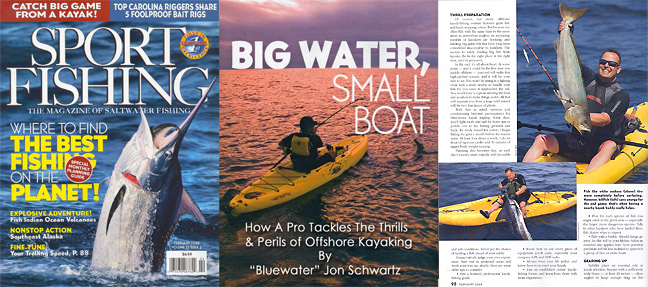
Big Water, Small Boat
By Bluewater Jon Schwartz © 2008 www.bluewaterjon.com
As featured in Sport Fishing Magazine - February 2008
|
Bluewater Jon's Note: Due to the length of this article I wrote for Sport Fishing Magazine, I've elected to include excerpts rather than reprint the entire piece. Don't forget: to learn how to fish safely and effectively from a kayak, hire a licensed, professional guide. The information in this article is only intended to add what you learn from a guide on the water, not replace it.
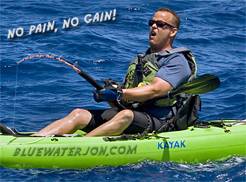
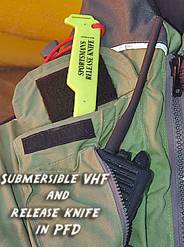
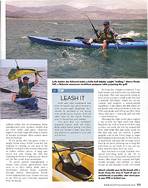
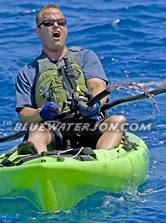
Within minutes, Heusser's reel screamed. He set the hook and his kayak lurched 90 degrees; the fish began towing his boat out to sea, waves breaking over the bow. I struggled to keep pace, but his fish was too powerful. I screamed into my tiny VHF, 'Dude, what are you hooked up to?' The radio dangling from my PFD barked back, 'I have no idea, but whatever it is, it's HUGE!'
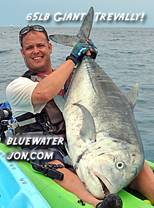
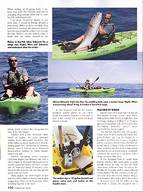
I buttoned down on the fish and it took off toward a jetty, obviously intent on breaking me off in the rocks. I upped the pressure. The trick worked and the fish changed course, heading out to sea. Twenty minutes later, my friend caught up with me as the whopping, 65-pound giant trevally popped up next to my kayak. Thrill Preparation
With that in mind, stamina and conditioning become prerequisites for blue-water kayak angling. Some days, you'll fight tooth and nail for hours just to paddle out to the fishing grounds and back. To ready myself for action, a month before the season starts I hit the gym 4 times a week, doing an hour of rigorous cardio and 30 minutes of upper body weight training. Planning also becomes key as each day's journey must coincide with favorable and safe conditions. Never put the chance of landing a fish ahead of your safety. If you have any health conditions or problems, get a doctor's approval before going kayak fishing.
Conservatively judge your own experience: Start out in protected areas and work your way up, slowly, over a period of years. Here are some other tips to consider: Hire a licensed, professional kayak-fishing guide. Know how to use every piece of equipment you'll carry, especially your compass, GPS, and VHF radio. Always wear your life jacket, and know how to re-enter your kayak. Join an established online kayak-fishing forum, and learn from those with more experience. See resources at end of article for a list. Plan for each species of fish you might catch in the given area — especially the larger more dangerous species. Talk to other kayakers who have landed these fish. Know what to expect. Fish with a buddy. Should things go awry, he will be your lifeline. Safety in numbers also applies here: Your potential predators will be less inclined to approach a group of two or more boats. Play Safe All recreational boats must carry one wearable personal flotation device (PFD) for each person aboard. Kayak anglers should go one step further and wear that PFD at ALL times. A US Coast Guard- approved Type III jacket style pfd offers rings and pockets for keeping gear on your body.
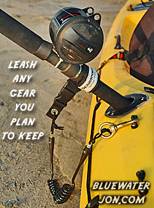
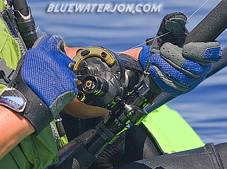
Choosing the right tackle gives anglers a say in how the fight plays out. Many kayakers use ro at least 7 feet long so they can work the rod tip around the bow. And while that may make sense for fish that stay near the surface, I prefer graphite rods in the 5-foot range to target hard-fighting brutes that aim for the bottom. A super-short rod puts the leverage factor back in my favor, allowing me to keep the rod closer to my body so I can use my back muscles rather than my arms. Reel selection is crucial. Graphite two-speed lever-drag reels in the 30- to 40-pound class, strung with 40-pound test mono, offer ample line capacity and lightweight strength, and provide as much torque as any kayaker could ever need. Whether trolling or dropping down, I use lever-drag reels. The freedom and ease of changing drag settings allow me to raise big fish and remain safe. I set drags 10% lighter on my reels than I would if fishing aboard a powerboat, and before I set the drag to strike, I make sure that I am solidly situated in my kayak, ready to brace the rod against the rail of the kayak if the fish lunges. Better to have too little drag and slowly increase the pressure than to have too much and be pulled over or snap the line.
If I'm dropping baits down to target big bottom fish like amberjacks or giant trevally, I'll only have one line out, but most other times, I'll have two lines out. To reduce the likelihood of tangles, as well as to target different depths of the water column, one bait will be flylined out on the surface with no weight, and the other will be kept down with an 2-8 ounce olive sinker placed above the swivel that ties to the leader. If the fish takes off horizontally, you're in luck: Nothing tires a fish more than towing an adult and his kayak. If the fish heads toward structure, tighten the drag and haul on the rod sharply several times in the opposite direction. The fish may be fooled into changing directions. If the fish heads for the bottom, I offer you my sincere condolences — you'll have to do all the hard work. Because kayak anglers can't pressure a fish as much as someone aboard a powerboat using a harness or fighting chair, the fish may become exhausted by the time it surfaces. Over the years, I've learned to resist the temptation to use extra light line. It stokes my ego but prolongs the fight and hurts the fish. I'd rather bring the fish up as soon as possible, so that I have the option of releasing it in good health.
Know Before You Go Big-game kayak fishing offers big thrills mixed with a dose of real danger. You don't have to be hooked up to Moby Dick or Jaws, or even a fish with teeth, to be injured or killed. Simply put, you can die kayak fishing. You can take a bad wrap on a leader and drown, take a blow or bite from a fish, or suffer injury from your own equipment or acts of nature. The odds of injury increase exponentially with the size of the fish. No matter who watches your back, being low on the water with a desperate animal attached to sharp hooks, and possibly a gaff, puts you in an unsafe situation. Not only can a big fish drown you, it may straight up attack you. To my knowledge, no kayak angler has been killed while kayak fishing, but that's just a matter of time as this particular aspect of the sport grows. (Actually, since the publication of this article, one kayak angler has died while kayak fishing from drowning or exposure). Don't become a casualty. Don't be the next to die. Cut loose any fish that poses a threat to your safety. Don't go out alone, and don't even launch unless you have all the safety gear, know how to use it, have a lot of experience, and have been trained by a professional. No fish is worth risking your life for. Before you commit to landing any large fish, gain enough experience, over a period of years, to know how to handle it, and know that something can go wrong no matter how well prepared you are. About The Author When he's not teaching elementary school in San Diego, 'Bluewater' Jon Schwartz travels the globe searching for new big game kayak fishing adventures. A member of the OWAA (Outdoor Writer’s Association of America), Jon has published articles in a variety of magazines, and owns his own video production company and kayak fishing consulting business, Bluewater Jon Productions, LLC. He's been kayak fishing since 2002. His website, www.bluewaterjon.com, features stories, photographs, and videos documenting his quests, and contains a thorough list of kayak-fishing websites, tips, equipment, information, and guides.
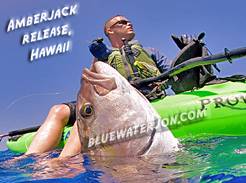
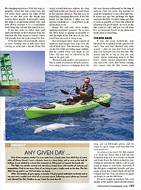
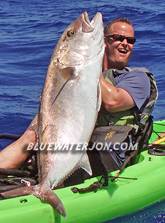
Any Given Day One of the toughest catches I've ever made from a kayak came from 400 feet of water, miles off of Kona, Hawaii. I sent a skipjack down to a deep ledge, and as soon as the bait hit bottom, it was inhaled by a beast that slammed my 80 pound rod against the kayak rail. The fight was strictly vertical and, therefore, brutal. Even with months of training and preparation, I had to use every fiber of my being to gain a single crank on the line. The fish didn't let up until it was 50 feet below my kayak. After 30 minutes of agony, a monster 70-plus pound amberjack surfaced, and as our eyes met, I couldn't tell which one of us was more spent. Following a quick photo op, I revived and released the fish. Needless to say, I took the next day off. Kayak Fishing Resources: Equipment:
1.
Kayak Fishing Stuff
http://www.kayakfishingstuff.com/
2. Melton's Tackle
http://www.meltontackle.com/
Kayak Fishing
Websites |
||||||||||||||||||||||||||
|
||||||||||||||||||||||||||