|
Bluewater
Jon's Note:
To
learn how to fish
safely and effectively
from a kayak,
hire a licensed,
professional guide.
The information
in this article
is only intended
to add what you
learn from a guide
on the water,
not replace it.
 |
4:30
am, Southern California
Coast
Ahh, nothing like
getting up early
and being the
first one on the
beach, I muse
as I make my way
down towards the
launch. My sense
of self satisfaction
evaporates as
I drive over the
last sand dune,
my headlights
revealing a bustling
crowd of anglers.
Much to my dismay,
there’s
already a long
row of rigged
kayaks, each armed
with enough rods
to outfit a small
party boat, resembling
a squadron of
battleships poised
for action. The
bite must be hot-
everyone’s
got their game
faces on, and
there’s
a palpable sense
of urgency in
the air. Three
anglers make it
past the breakers,
precipitating
a feeling of restlessness
among those left
watching. Like
lemmings, the
rest drag their
kayaks past the
surf into the
dark haze, and
within minutes,
I’m alone.
I’m tempted
to rush in after
them- their bait
tanks’ll
be full of greenbacks
before I’m
even in the water!-
but I have an
appointment- an
appointment with
Dark Horse.
Just
before the clock
strikes 5:00,
a lone pair of
headlights illuminates
the surf’s
mist in front
of me. He has
arrived. Unlike
the rest of us,
his manner is
calm and unrushed.
I stare at my
watch and pace
in the sand as
he methodically
secures his seat,
bait tank, and
fish finder. This
guy’s either
lazy...or he knows
what he’s
doing...
As
we paddle out
to the fishing
grounds, he lays
out our plans
for the day. “The
current has been
slow in the morning
and there’s
been no nervous
bait till the
pm shift, so we
only have a 10
percent chance
of landing a white
seabass. We’ll
make bait just
in case though,
troll the outside
ledge, and once
everyone’s
off the water
at 10:00, the
yellows will come
out to play, and
we’ll have
them all to ourselves...”
Though
his predication
reeked of optimism
and overconfidence,
I tagged along
gamely. Sure enough,
the hours passed
by, and the yakkers’
chatter on my
handheld submersible
VHF confirmed
his forecast-
no one had so
much as a raked
bait. One by one,
the anglers I
saw on the beach
that had bristled
with such energy
and expectation
in the predawn
hours paddled
by us in silent
resignation, and
by 10:00- almost
to the minute-
we were the only
two out on the
water.
Using
triangulation,
he directed us
towards the spot
in the open water
where he promised-guaranteed,
really- that he’d
show me schools
of yellowtails
breezing on the
surface. “I
need you to be
on my left so
I can see them
coming”
he stated as he
rose on his knees
to get a better
view of things,
“and lose
that mac you’re
trolling-we won’t
be using bait
until the paddle
home at sunset.”
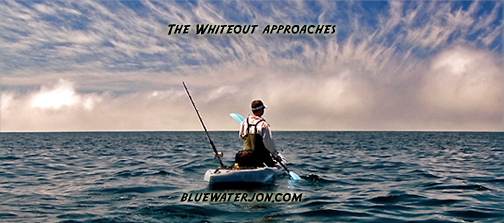
I
snapped a couple
of photos and
noticed a spectacular
pattern of clouds
forming to the
West. Twisted
fingers of mist
swirled out from
a fog bank on
the horizon. Instantly
our game plan
changed- we knew
we had mere minutes
to make it to
shelter before
we were completely
enveloped in a
dangerous whiteout.
The
kelp offered us
the nearest refuge,
and no sooner
did we tie off
the sterns of
our kayaks to
some healthy fingers
of kelp than 20
knot gusts of
wind began to
buffet our tiny
plastic crafts,
making a howling
sound as they
churned up the
once calm water
into a sea of
whitecaps. The
kelp held true,
and we managed
to ride out the
passing front
after 45 minutes
of fairly hairy
conditions.
Once
again the skies
opened up, and
we paddled back
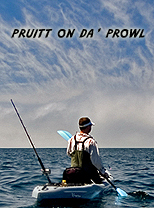
to the spot. Dark
Horse assumed
the unorthodox
lookout post on
his knees, and
after several
hours of plying
the waters, the
first school of
yellows came into
view. I should
say, his view-
I never saw them
coming, until
they were right
next to my kayak-
but what a sight!
At least 20 of
them, a good 25-35
pounds each, mere
inches below the
water, and not
more than 6 feet
off my starboard.
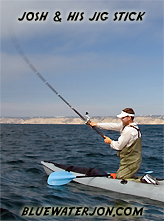
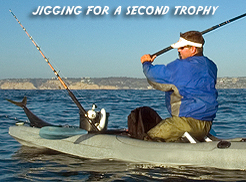
Sensing
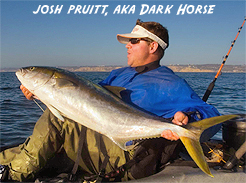
his moment, Dark
Horse took out
his Seeker Ulua
9’3”
40-60# jig stick
loaded with 40
pound, and threw
a Salas 7x Blue
and White well
past the school.
After a few cranks,
the line came
taught, and the
sleigh ride began.
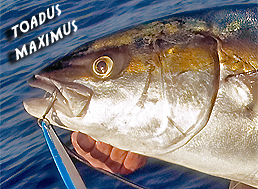
10 minutes later,
he’s slipping
a game clip through
a 34 pound yellowtail’s
gills. I guess
he knew what he
was doing after
all!
By
the time we returned
to shore- 14 hours
after we’d
launched- I had
peppered him with
enough questions
to make a 5 year
old blush. How
did he know my
bait wasn’t
going to get bit?
How’d he
put us directly
in the path of
a marauding school
of yellows? Answer:
hard work. It
turns out that
Dark Horse- aka
Josh Pruitt- gained
his knowledge
by spending huge
amounts of time
on the water on
his small stealthy
craft, observing
the offshore environment
in it’s
natural state.
Because
kayaks are relatively
slow, can’t
haul around a
great deal of
gear, and have
a tiny amount
of work space,
many kayakers
have, by necessity,
learned to maximize
each process and
window of opportunity.
Some have honed
their knowledge
of fish behavior,
effects of tide,
current, water
temp, moon phase,
and observational
skills to a level
previously associated
with top sport
fishing captains.
This article will
discuss some of
the basics of
kayak fishing,
and will also
delve into some
more advanced
information that
readers can strive
to make use of
on the water.
Before we do that,
though, let us
consider safety.
Safety
Hire a licensed,
professional
guide, such
as Jeff
“Rhino”
Krieger
or Jim Sammons
of La Jolla
Kayak Fishing
(see resources)
and never
fish alone.
Look for
Josh Pruitt
himself
to be starting
up his own
guiding
service
as well!
I strongly
recommend
joining
an online
kayak fishing
discussion
board. There,
you will
be able
to meet
fishing
partners
and find
more detailed
answers
to the many
questions
you’ll
have. Start
out on small
fish, in
protected
waters.
Always wear
a PFD, file
a float
plan, carry
a submersible
VHF radio,
first aid
kit, duct
tape, GPS,
manual bilge
pump, cell
phone in
waterproof
case, whistle,
headlamp,
compass,
and flashlight.
Learn how
to re-enter
your kayak.
Tether your
rods and
gear to
your yak.
Consult
online websites
for recent
information
on weather,
paying particular
attention
to wind,
current,
and swell
conditions.
|
 |
Adi
Ljubovic, of Socal’s
own Kayak Fishing
Supplies and the
popular website
Big Water’s
Edge, relates
“I won’t
launch if the
wind is over 10
knots or the swell
is over 3 feet,
and if I hear
there’s
a possibility
for Santa Anna
offshore wind
conditions, I’ll
stay home.”
Because
you’re doing
it all yourself-
prepping your
gear, getting
to the grounds,
catching bait,
finding, hooking
and landing the
fish- the potential
rewards of kayak
fishing are without
parallel- but
so are the perils.
Consider
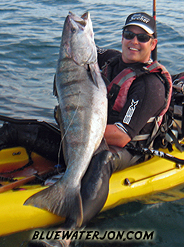
this tale: a newcomer
to the sport,
whose prior experience
consisted of kayak
fishing Dana Point
Harbor, hit the
jackpot on his
maiden offshore
kayak voyage,
landing a 40 pound
white seabass.
The
next morning at
the launch, he
proudly showed
me his impressive
collection of
gear, including
a shiny new kayak
emblazoned with
the sticker Fear
No Fish. Hours
later and miles
from shore, I
saw someone fall
off their kayak,
and paddled over
to lend a hand.
The angler had
a look of panic
of his face; he’d
lost every last
piece of equipment
as he’d
neglected to secure
them to his kayak,
and his PFD was
floating 20 yards
away- he wasn’t
wearing it when
he flipped. Once
I helped him right
his craft, I saw
the Fear No Fish
sticker, and only
then realized
it was the same
fellow I’d
met that morning
on the beach!
Lastly,
as Socal big game
kayak fishing
pioneer and guide
Jeff “Rhino”
Krieger (of Threshers
Yak Style fame)
advises, cut loose
any fish that
poses a threat
to your safety
while minimizing
the amount of
line that trails
behind the fish,
and don’t
attempt to land
any fish unless
you know you can
handle it.
|
Bait
Tanks
Kayakers’s
interest in
constructing
the perfect
bait tank
seems to border
on the obsession.
The basics
stay the same-
small battery
powering a
bilge pump
that draws
water into
a container
somewhere
on the kayak-
but the variations
are endless.
There’s
videos on
how to build
your own,
endless how-to’s
on yakking
websites,
and nowadays,
you can buy
your own pre-made
outfits. Heck,
one particularly
crafty company,
Angler’s
Yak Shack,
installs custom
bait tanks
inside kayaks!
Rods,
Reels &
Line
Anglers
often take
four 7 foot
rods on
their yaks
in the 30
pound class.
They’ll
have a rod
or two set
up for bait,
often running
simultaneously,
one straight
to hook
for flylining,
the other
set up with
a 2-3 oz
sinker Carolina
style to
reach fish
father down
the water
column.
For years,
yakkers
lost many
fish that
lodged themselves
in the kelp.
Now, many
use 50 pound
braid tied
with a small
swivel to
a short
2-5 foot
30 pound
|
flourocarbon
leader. The braided
line cuts through
the kelp, sometimes
enabling the angler
to raise prizes
they’d have
to give up on until
recently. Two rods
may be set up for
a combination of
surface and bottom
jigs, and if the
angler’s jig-stick-savvy
like Pruitt, they
may have one onboard
strung up with 40#
line.
Launching
Where’s
the hot spot?
You’ll have
to do some of
your own research
on that! The truth
is, trophy white
seabass have been
landed by kayakers
from Ventura,
Malibu, and all
points Southward,
and until recently,
the biggest yellowtail
I had landed was
in Encinitas,
so go figure.
Chances are if
you see a large
patch of kelp,
there’s
bait, and where
there’s
bait, there’s
predators. In
this article,
we’ll focus
on putting you
on two of the
tastiest: yellowtail
and white seabass.
Making
Bait
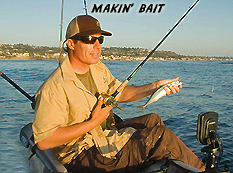
To locate bait,
you’re going
to want to find
some structure
towards the surface,
such as kelp or
a pier. Get a
fishfinder. You
may elect to attach
the unit on a
removable mount
on the deck, securing
a transducer permanently
on the interior
floor of your
craft, or use
a portable model
like the Humminbird
PiranhaMax 215
with a suction
mount transducer
stuck under your
hull. Locate densely
packed schools
of bait. If you
can’t find
them, chum with
some cat food,
tuna fish, or
dried bread crumbs,
and jig a bait
making Sabiki
rig up and down
at different depths.
Tip the tiny hooks
with small pieces
of squid , and
tie a 3-4 oz Crocodile(without
hook) to the swivel
end to add flash
and get the rig
down quickly.
Some yakkers have
dedicated bait
rods, while others
choose to switch
out their bait
rigs with an iron
once they’ve
filled their tanks.
Many kayakers
swear by greenback
mackerel, while
others say that
spanish macs are
equally effective.
 |
Trolling
Bait
Pruitt recommends
nose hooking
your baits
using a
hook that
matches
the width
of your
bait’s
nose, and
cautions
against
using oversized
hooks. “Besides
providing
an unnatural
presentation,”
says Pruitt,
“larger
hooks also
have the
tendency
to foul
hook the
bait, resulting
in a missed
opportunity
from your
one strike
of the day.”
When the
fish aren’t
biting,
he’ll
downsize
his hooks
and line
size, switching
from 30
to 20 pound
line.
According
to Pruitt,
yellows
prefer baits
flylined
at the surface,
while the
seabass
will go
for baits
20-30 feet
down the
water column-
your weighted
rigs. Getting
the right
bait is
crucial.
Sometimes
6-8 inch
macs will
do just
fine. However,
if the yellows
are keyed
in on sardines,
they’ll
rarely hit
mackerel,
so he’ll
use a light-line
sabiki at
greylight
to load
up on sardines.
Conversely,
in summer,
he relates,
”When
the entire
ocean forces
itself upon
our local
waters,
including
bonito,
barracuda,
and small
yellowtail,
I’ll
use larger
baits- macs
up to 12
inches-to
prevent
bycatch.
Larger,
healthy
baits tend
to entice
strikes
only from
yellowtail
|
|
and
last longer
on the hook.”
Changing
out your
baits regularly
will enhance
your chances
of enticing
a strike.
Baits are
trolled
anywhere’s
from 20-50
yards behind
the yak
at slow
paddling
speeds,
with the
reel’s
clickers
set just
tight enough
to keep
the bait
from pulling
line.
Your
kayak will
allow you
to nuzzle
right up
to the white
ghosts’
lairs in
the kelp,
but when
targeting
yellows,
stay much
farther
away from
these dense
underwater
forests;
being much
harder fighters
pound for
pound, they
are much
harder to
wrest from
the kelp
once they’ve
found sanctuary.
Fish
Think |
 |
Yellowtail
and white seabass
also contrast markedly
in the way they’ll
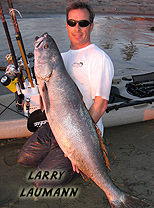
strike baits. According
to Pruitt, yellowtail
prefer a strong
current and eat
baits quickly. In
contrast, white
seabass- even 50
pounders- are generally
apprehensive when
eating, prefer to
inspect the bait
thoroughly, and
nibble on baits
before they fully
commit.
I
have personally
found this to
be a nerve-wracking
proposition. I’ve
been in close
to the kelp and
heard the clicker
start to chirp,
indicating a predator
is slowly approaching
my nervous bait.
Guessing the fish
is a seabass,
I have to wait
patiently until
he runs with it
for at least several
seconds; at the
same time, I know
that the longer
I let it run,
the greater the
chance that they’ll
bury themselves
in the kelp.
Pruitt
points out a similar
Catch.22 scenario
with an unlikely
candidate: the
40+ pound homeguard
yellows. Because
they’re
older and wiser,
he recommends
choosing a lighter
stretch of flouro
leader-down to
20, or even 15-
pounds. You’ll
have to use some
finesse and get
lucky to raise
a fish of that
size with such
a light leader,
of course; that’s
why you don’t
see too many anglers
boating these
beasts!
 |
 |
Landing
Fish
In addition to
keeping your fish
out of the kelp,
you’ll likely
have to contend
with sea lions
at some point.
Not only will
they sometimes
follow you around
and steal your
baits- they may
devour your trophy
as it sulks beneath
you during a protracted
fight. If you
manage to get
the fish up unmolested,
sink a gaff into
its head or shoulders,
pull it onto your
lap, insert a
game clip through
it’s gills,
and stow the fish
across your legs,
on the kayak’s
tankwell, or in
your front hatch.
Leaving it in
or near the water
will attract sea
lions and possibly
sharks, so, uh,
don’t.
 |
Conclusion
Southern
California
offers some
of the best
yellowtail
and white
seabass
fishing
in the world,
and as a
kayak angler,
you’ll
have the
opportunity
to fully
exploit
the immense
potential
of this
region.
The thrill
of landing
a trophy
on a kayak
is matched
by an increase
in risk
factors.
Conditions
can change
in an instant,
and the
lake-like
conditions
that you
paddled
out it in
can quickly
morph into
a frothing
cauldron.
Be cautious,
conservative,
and curious;
anyone can
get lucky,
but to safely
catch fish
on a consistent
basis, you’ll
have to
study the
sport and
the ocean
diligently. |
|
|
About
The Author
When he's not
teaching elementary
school in San
Diego, 'Bluewater'
Jon Schwartz travels
the globe searching
for new big game
kayak fishing
adventures. His
website, www.bluewaterjon.com,
features stories,
photographs, and
videos documenting
his quests, and
contains a thorough
list of kayak
fishing websites,
tips, equipment,
information, and
guides. A member
of the OWAA (Outdoor
Writer’s
Association of
America), Jon
has published
articles in Sport
Fishing Magazine,
Pacific Coast
Sport Fishing,
Big Game Fishing
Journal, The Gringo
Gazette, Canoe
& Kayak Online,
Marlin World,
appeared in Field
& Stream,
and operates a
multi-media consulting
business, Bluewater
Jon Productions,
LLC. He's been
kayak fishing
since 2002, and
recently hooked,
fought, and released
8 marlin from
his kayak in 2
days.
You
can view footage
from that event
by clicking here.
If you need an
article written
for your publication,
footage for your
network, or just
want to chat,
drop him a line-
he’d love
to hear from you!
Kayak
Fishing Websites
in ABC Order
|